
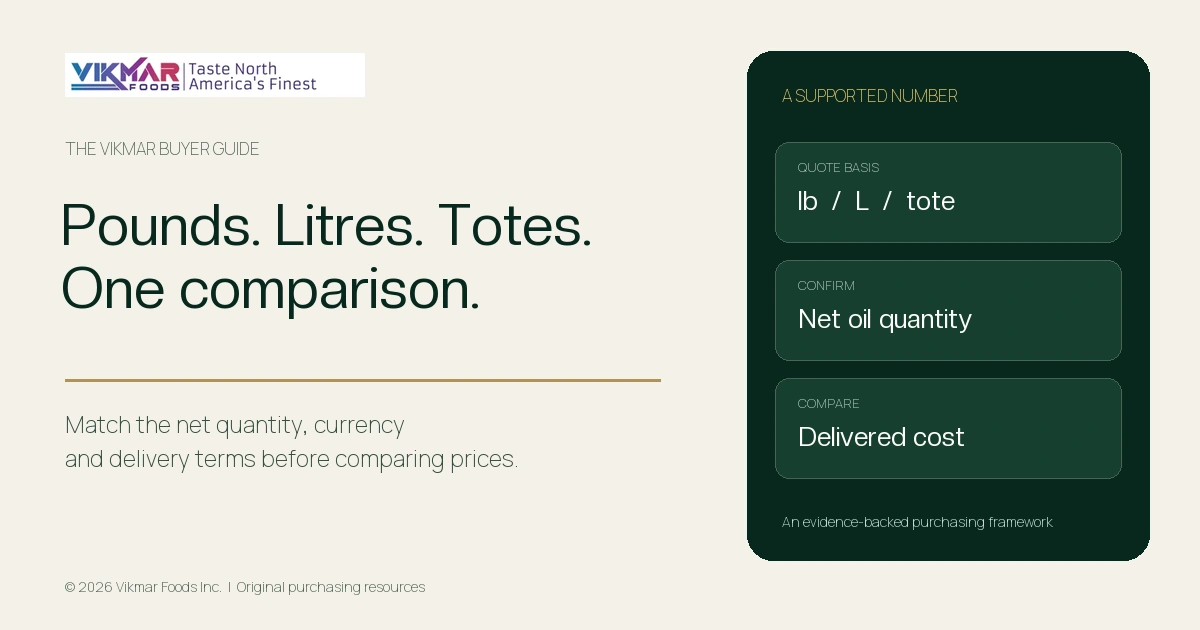
A cooking-oil quote arrives at CAD 1.00 per pound. Another arrives at CAD 2,100 per tote. Both may describe a suitable product, yet the numbers cannot tell you which offer costs less until you know how much oil each price buys and what it costs to deliver that oil to the same place.
Start with the quantity behind the price. A tote is a packaging format; a pound is a unit of mass. Add a quote in litres, a freight charge and a refundable container deposit, and an apparently simple purchasing decision can become a spreadsheet full of mismatched assumptions.
This guide gives you a repeatable way to compare those offers. Choose one currency and one quantity unit, confirm the net oil content, then divide consistently defined costs by that quantity. The accompanying worksheet records the evidence behind each input, so another buyer can check your calculation without reopening every email.
Match the product before comparing the price
Agree on the oil specification first. A refined canola oil, a particular oil blend and an oil selected for a demanding frying application should not be treated as interchangeable merely because their descriptions all contain the words cooking oil. Confirm the product identity, intended application and the current specification relevant to your operation before ranking quotes.
The same applies to commercial requirements. Record the delivery location, order quantity, required timing, packaging and quote validity alongside the product description. A price for a full shipment to one address is not automatically available for a single tote delivered elsewhere, even when the supplier and product name are identical.
Use a simple eligibility column. Mark each offer as suitable, awaiting clarification or outside the agreed brief. Calculate the price comparison for suitable offers, and keep unanswered questions visible instead of making the lowest number look more certain than the information supporting it.
Separate container size, net contents and shipping weight
These quantities answer three different questions. Container capacity describes the space available in the package. Net contents describe the oil supplied. Gross shipping weight includes the oil plus its packaging, which may include the container, cage and pallet depending on the document's stated boundary.
Net mass is gross mass minus tare mass when both measurements cover the same package and use the same unit. NIST's Weighing and Scales FAQs distinguishes the product content from packaging tare and also explains why rounding on a weighing instrument can affect the displayed arithmetic. Use the supplier's documented net quantity rather than quietly subtracting an estimated empty-container weight.
A capacity label needs a follow-up question. Ask whether a quoted 1,000 L describes the agreed net oil fill or the nominal capacity of the tote, and ask which quantity will determine the invoice. If the offer is priced by measured net mass, record that basis directly; you may not need a density conversion at all.
Vikmar's current catalogue identifies IBC totes as 1000 Liter and drums as 55 Gallon | 208 Liter. Those format descriptions help you start the packaging conversation. For a purchasing comparison, confirm the net fill and invoicing basis in the actual quotation rather than deriving them from a product image or treating a rounded format description as a weighing record.
Canadian food-labelling guidance makes a related distinction between consumer packages and other prepackaged foods. The Canadian Food Inspection Agency's Net quantity on food labels page discusses net-quantity declarations and points to Measurement Canada for the Weights and Measures Act requirements concerning other prepackaged formats. A comparison worksheet is a buying tool, not a substitute for the applicable labelling or trade-measurement requirements.
Choose one quantity unit and use it throughout
Pick a unit the evidence supports. Kilograms are convenient when one offer is per pound and another has a confirmed net mass. Litres can work just as well when every supplier provides a reliable net volume on a compatible reference basis. The important choice is consistency, not a preference for one side of the border.
Convert pounds to kilograms without guessing
For the ordinary avoirdupois pound used in this comparison, 1 lb = 0.45359237 kg. NIST's 2026 Handbook 133, Appendix E, gives that conversion. Keep the full factor in the calculation and round the displayed result at the end.
- Net kilograms = net pounds × 0.45359237.
- Price per kilogram = price per pound ÷ 0.45359237.
The direction matters more than it looks. Because a kilogram contains more than one pound, a price of CAD 1.00 per pound becomes approximately CAD 2.2046 per kilogram before freight. Multiplying the price by 0.45359237 would produce the wrong unit cost, even though multiplying the quantity by that factor is correct.
Convert litres to kilograms only with a supported density
Mass and volume need a bridge. That bridge is density, expressed here in kilograms per litre, for the actual product at the relevant temperature. Use net kilograms = net litres × density in kg/L, with the volume and density referring to compatible conditions.
NIST's 2026 Handbook 133 explains that liquid volume changes with temperature and that density used in volume testing is tied to a reference temperature. That supports asking for the product and temperature basis; it does not give you a universal conversion factor for every cooking oil. Ask for an appropriate specification or measurement record, and avoid substituting water's familiar one-kilogram-per-litre shortcut.
Do not confuse density with relative density. A dimensionless value comparing oil with reference water is not automatically a mass-density value in kg/L. If a specification says specific gravity or relative density, ask the supplier to explain the reference conditions and provide the conversion appropriate to the quoted quantity.
Write out which gallon is intended
A gallon needs an explicit definition. One US liquid gallon is 3.785411784 L; an Imperial gallon is 4.54609 L. The US value is given in NIST's 2026 unit tables, and the distinction is also shown in its Guide to the SI conversion tables.
That difference is large enough to matter. Fifty-five US liquid gallons are approximately 208.20 L, while 55 Imperial gallons are approximately 250.03 L. Clarify an unqualified gallon on a quotation, then use the agreed net contents rather than treating a drum's rounded format name as an exact fill measurement.
Compare costs at the same delivery point
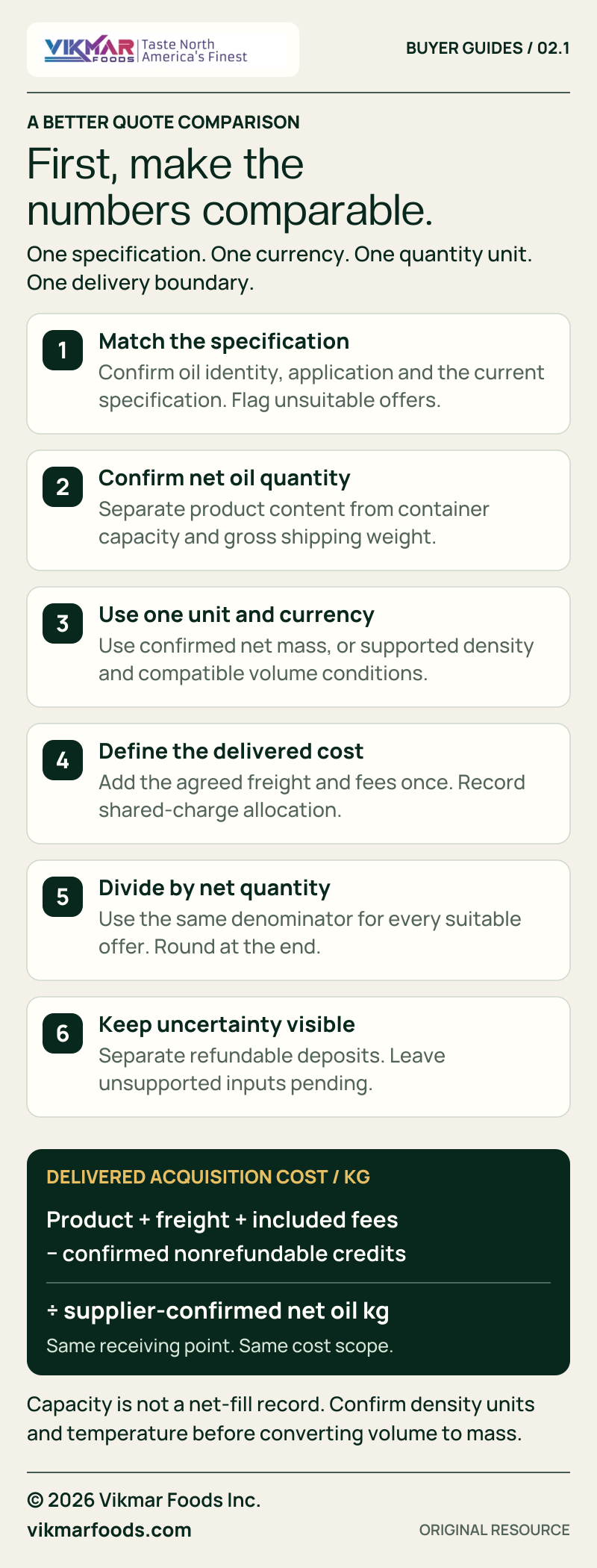
Set the comparison boundary before adding charges. A useful starting measure is delivered acquisition cost per kilogram: the product charge plus the agreed costs of getting that shipment to your named receiving point, divided by its net oil mass. Apply the same scope to every candidate.
Delivered acquisition cost per kg = (product charge + allocated freight + included fees − confirmed nonrefundable credits) ÷ net oil kg.
Specify what each line includes. Depending on the offer, the questions might cover delivery, handling, fuel surcharges, appointment charges, duties or other destination-related costs. Some will be included, some may be separate and some will not apply. Check the quotation rather than copying a generic list into the total as though every charge were inevitable.
Count each charge only once. If freight is already included in a delivered product price, do not add it again. If one shipment carries several products, record the allocation method used for its shared freight. A mass-based allocation and a pallet-position allocation can produce different figures, so use a method relevant to that shipment and apply it consistently.
Keep deposits on a separate line. A refundable container deposit increases the cash needed for the order, but treating it as a consumed ingredient cost can distort the comparison. Record its conditions, expected return and timing separately; include any genuinely nonrefundable fee in the appropriate cost line instead. Review taxes and their recoverability with your finance team before choosing the comparison's tax treatment.
Cross-border quotes need a currency rule. Convert all included amounts to the same currency using one recorded rate convention and date, then identify any actual conversion charges separately. The calculation should not quietly compare CAD 1.00 per pound with USD 1.00 per pound or describe a convenient planning rate as a guaranteed settlement rate.
A worked example: the lower product price loses after freight
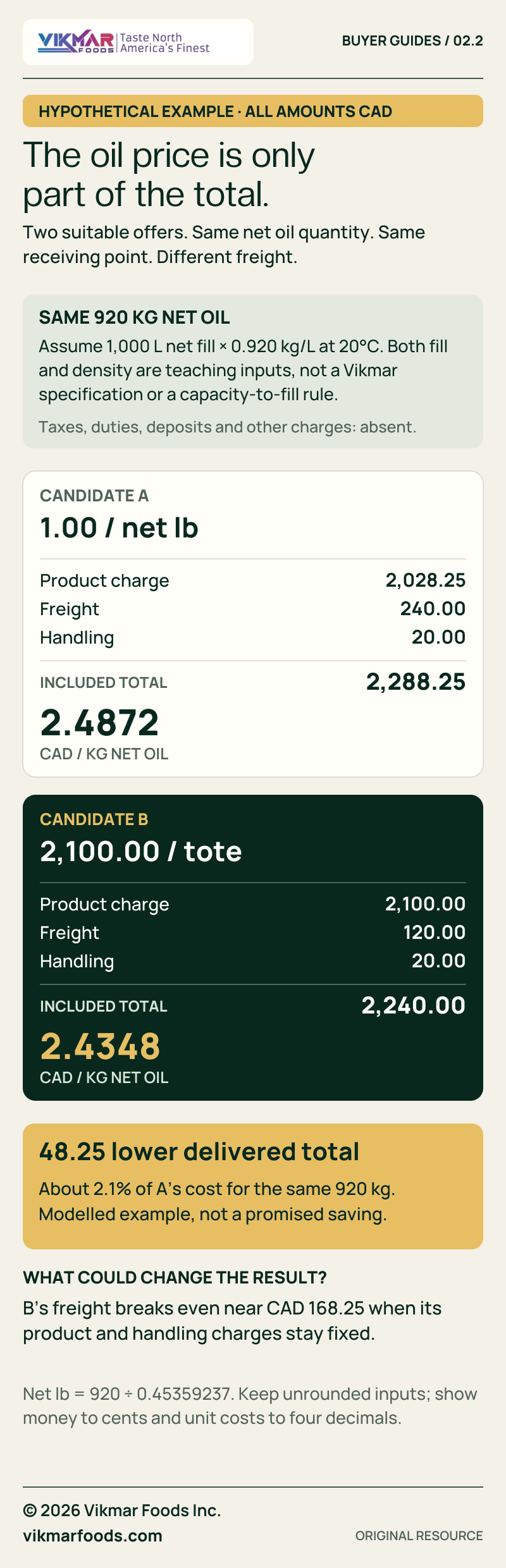
The following comparison is entirely hypothetical. These are invented teaching inputs, not Vikmar quotations, market prices, customer savings or laboratory results. Assume both offers meet the same specification and supply one tote containing an agreed 1,000 L net fill, modelled as 920 kg using an assumed density of 0.920 kg/L at 20°C.
The density is an illustration only. It is not a recommended default for purchasing, and the example's stated net fill must not be inferred from the capacity of every tote. In a real comparison, replace those assumptions with the supplier-confirmed quantity and the relevant product record.
Both offers use Canadian dollars and the same receiving location. Candidate A charges CAD 1.00 per net pound plus CAD 240 freight and CAD 20 handling. Candidate B charges CAD 2,100 per tote plus CAD 120 freight and CAD 20 handling. Taxes, duties, deposits and all other charges are assumed absent from the comparison.
| Hypothetical input or result | Candidate A: per net pound | Candidate B: per tote |
|---|---|---|
| Net oil mass for the comparison | 920 kg | 920 kg |
| Equivalent net pounds | approximately 2,028.2528 lb | approximately 2,028.2528 lb |
| Quoted product price | CAD 1.00/lb | CAD 2,100/tote |
| Product charge, displayed to cents | CAD 2,028.25 | CAD 2,100.00 |
| Freight | CAD 240.00 | CAD 120.00 |
| Handling charge | CAD 20.00 | CAD 20.00 |
| Total included cost | CAD 2,288.25 | CAD 2,240.00 |
| Delivered acquisition cost per kg | CAD 2.4872/kg | CAD 2.4348/kg |
On a small screen, swipe the table to compare columns.
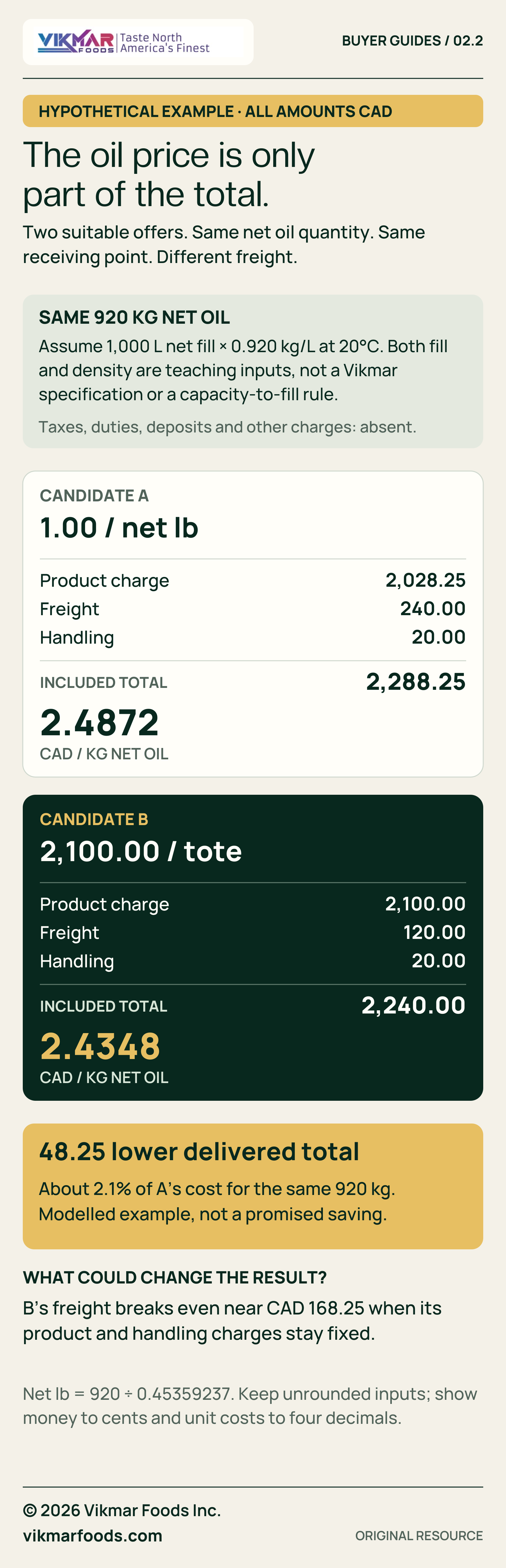
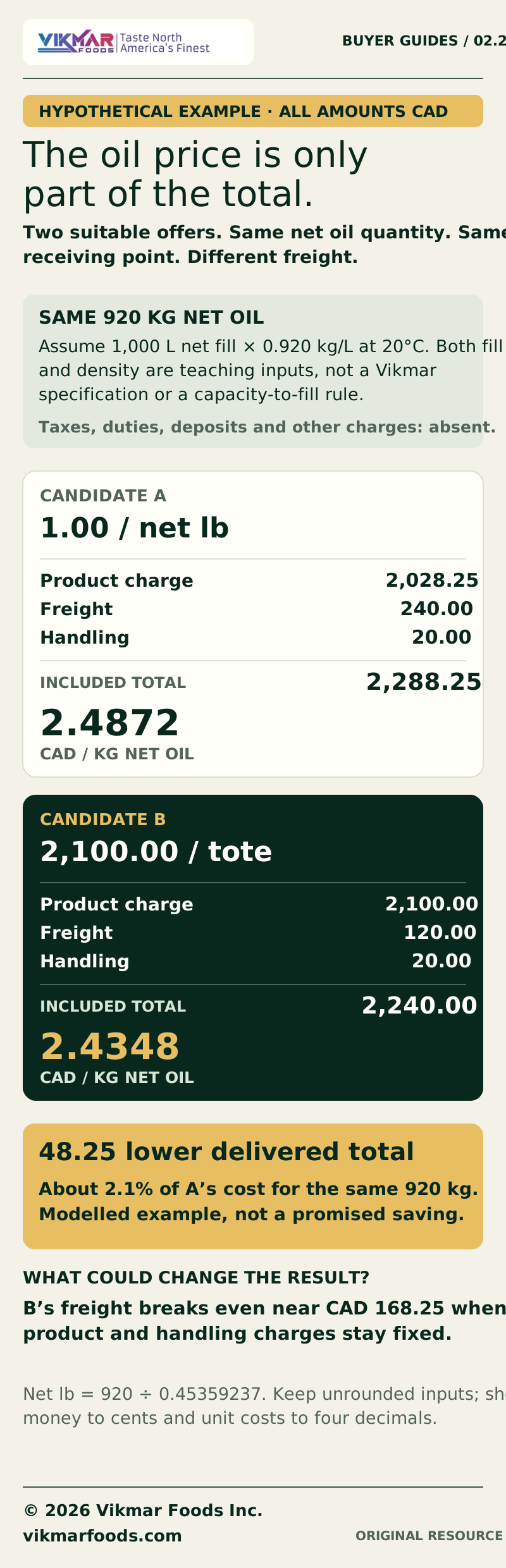
Candidate A has the lower product charge. Candidate B has the lower delivered total, because its freight advantage exceeds the difference in the oil price. The modelled difference is CAD 48.25 for the same 920 kg, or about 2.1% of Candidate A's included cost.
Retain precision behind the displayed figures. Candidate A's net pounds are calculated as 920 ÷ 0.45359237, and its total uses that unrounded result. The displayed price per kilogram is rounded to four decimals for comparison; an actual invoice should follow the commercial rounding basis agreed with the supplier.
Find the freight point that changes the result
The example also offers a negotiation question. With Candidate B's product charge and handling fixed, its freight could rise from CAD 120 to approximately CAD 168.25 before its included total matches Candidate A. That threshold is derived from Candidate A's unrounded total minus CAD 2,100 minus CAD 20.
Use the threshold as a question. It tells you which missing freight amount could change this particular comparison, rather than predicting a freight rate or instructing either supplier what to charge. If the order size, product price or fee structure changes, calculate it again.
See what the wrong denominator does
An assumed 1,000 kg would flatter the result. Dividing Candidate B's CAD 2,240 by the tote's 1,000 L figure as though litres were kilograms produces an incorrect CAD 2.24/kg. In this hypothetical model, the proper mass denominator is 920 kg and the result is CAD 2.4348/kg.
That mistake understates the correct figure by 8%. It happens before any dispute about freight, quality or payment terms, and it illustrates why a cheap-looking tote price is meaningless without a supported quantity denominator. Changing the container label does not change the mass of oil in the calculation.
Use the quote comparison worksheet for your next order
Make every input traceable to a document. The downloadable blank worksheet pairs Candidate A and Candidate B with an evidence column, while the completed example demonstrates the calculation order without asking you to accept its fictional values. Keep the original quotation and any clarification alongside the worksheet.
Download the blank comparison worksheet · Download the hypothetical completed example
| Worksheet field | What belongs in it | If the answer is missing |
|---|---|---|
| Product and specification | Oil identity, application and agreed specification reference | Ask before ranking the offer |
| Commercial basis | Quote date, expiry, order quantity and delivery point | Obtain a comparable offer |
| Net quantity | Confirmed net mass, or net volume with supported conversion | Leave the unit-cost result pending |
| Quantity evidence | Supplier document, density units and reference conditions where needed | Record the clarification required |
| Currency | Comparison currency, rate convention and date if conversion is needed | Keep currencies separate |
| Included charges | Product, freight, defined fees and confirmed credits | Identify what is included already |
| Separate cash items | Refundable deposits and agreed tax treatment | Ask finance or the supplier |
| Comparison result | Total included cost divided by net oil quantity | Show unrounded calculation and rounded display |
| Decision note | Specification fit, unresolved items and relevant operating constraints | Explain why price alone is insufficient |
On a small screen, swipe the table to compare columns.
Keep the evidence column practical and short. A quotation reference, document revision or dated supplier confirmation is more useful than an unexplained green tick. If a promised container credit has return conditions, write those conditions down rather than assuming that the credit will appear automatically.
A separate operating comparison may still be needed. A lower delivered acquisition cost does not establish fryer life, finished-food quality, transfer efficiency or suitability for your process. Those questions depend on the actual application; our earlier guide to frying-oil cost per 100 portions explains how to define a different denominator when the decision concerns kitchen output.
Send a purchasing brief that gets comparable answers
A useful enquiry makes the comparison possible. Include the oil and application, specification requirements, preferred packaging, proposed order quantity, delivery location and timing. Ask for net contents, the invoicing unit, the included delivery charges and the terms governing container fees or deposits.
Here is a brief you can adapt:
Please quote the following oil and specification for delivery to our named receiving location. State the net oil content per package, the price unit and currency, the quantity on which invoicing will be based, and whether freight and handling are included. If a volume-to-mass conversion is needed, identify the product density, its units and the relevant temperature basis. Please list separate charges, refundable container deposits and their conditions, quote validity, and the documents available for reviewing the product specification.
Start with a format your operation can handle. You can review Vikmar's bulk range, canola oil in IBC totes and canola oil in drums, then request a quotation with the details needed for your comparison. Specifications, availability and commercial terms are confirmed for the actual order.
The useful number is a supported number. Once every eligible quote uses the same currency, delivery boundary and net-quantity denominator, the price comparison becomes easier to check and easier to explain. You can negotiate the missing term that matters, rather than guessing which differently sized number ought to win.
About the research and sharing these resources
This guide draws on NIST's 2026 Handbook 133 measurement and unit tables, its Weighing and Scales FAQs and Unit Pricing Guide, and current Canadian Food Inspection Agency net-quantity guidance. The comparison method, worksheet and illustrations are original Vikmar editorial resources. They are proposed purchasing aids, not a study, official inspection procedure or product-performance validation.
Created by Vikmar Foods Inc. Please credit Vikmar Foods when sharing these resources; a link to Vikmar Foods helps readers find the company and its published guides. Attribution is welcome and voluntary.